

Choosing the right pixel pitch for an LED display is one of the most important decisions when planning an LED video wall project. Pixel pitch directly affects image clarity, viewing distance, display cost, and overall user experience.
Many buyers focus only on screen size or price but overlook pixel pitch selection. Choosing a pixel pitch that is too small can increase costs unnecessarily, while choosing one that is too large may result in poor image quality.
This guide explains how to choose the right pixel pitch for LED display, including viewing distance, application scenarios, budget considerations, and common LED pixel pitch options.
一、What Is Pixel Pitch in LED Display?
Pixel pitch refers to the distance between the centers of two adjacent LED pixels, measured in millimeters (mm).
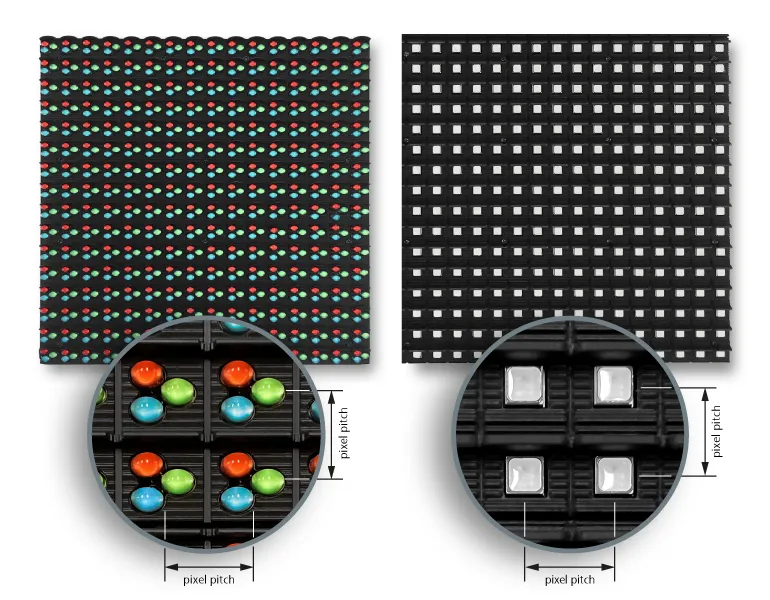
For example:
- P1.2 LED display = 1.2mm pixel pitch
- P2 LED display = 2mm pixel pitch
- P3 LED display = 3mm pixel pitch
- P5 LED display = 5mm pixel pitch
The pixel pitch determines the pixel density of an LED screen.
Smaller pixel pitch means:
- Higher resolution
- More detailed images
- Better close-distance viewing
- Higher cost
Larger pixel pitch means:
- Lower cost
- Lower resolution
- Suitable for longer viewing distances
二、Why Choosing the Right Pixel Pitch Matters
The correct pixel pitch helps achieve the best balance between:
- Image quality
- Viewing experience
- Project budget
- Application requirements
A wrong choice may cause two problems:
1)Choosing Too Small Pixel Pitch
Example:
Using a P1.2 LED display for a large outdoor billboard.
Problems:
- Higher investment cost
- Limited visible improvement
- Unnecessary specification upgrade
2)Choosing Too Large Pixel Pitch
Example:
Using a P6 LED display in a small conference room.
Problems:
- Visible pixels
- Poor text clarity
- Lower professional appearance
三、The Most Important Factor: Viewing Distance
The primary rule for selecting LED pixel pitch is:
The closer the audience is to the LED screen, the smaller the pixel pitch should be.
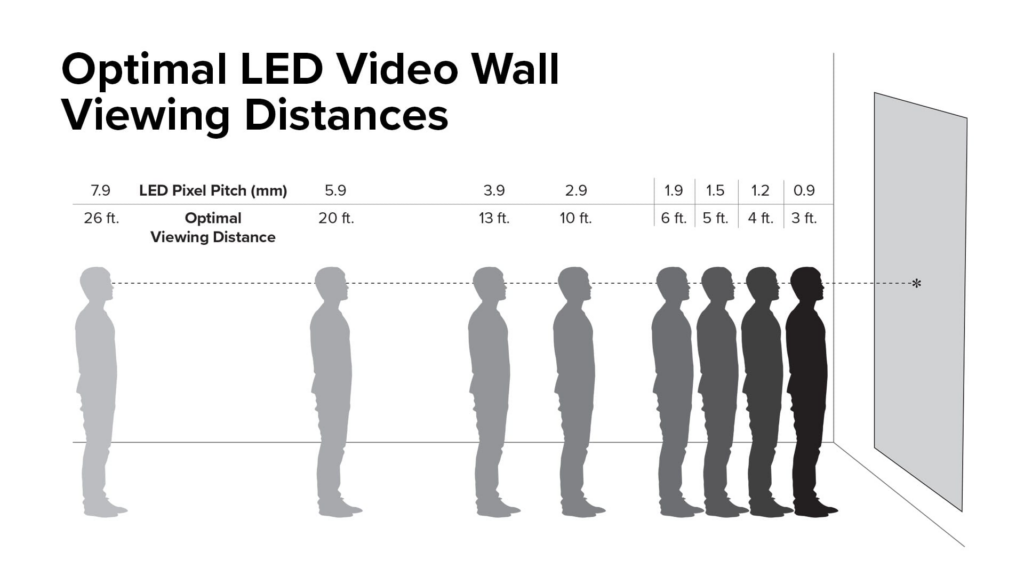
A simple industry guideline:
Minimum viewing distance (meters) ≈ Pixel pitch (mm)
Examples:
- P1.5 → approximately 1.5 meters minimum viewing distance
- P3 → approximately 3 meters minimum viewing distance
- P5 → approximately 5 meters minimum viewing distance
For the best viewing experience:
Optimal viewing distance ≈ Pixel pitch × 2–3
四、LED Pixel Pitch Selection Guide by Application
1. Conference Room LED Display
Conference rooms usually have close viewing distances and require sharp text.
Recommended pixel pitch:
- P0.9–P1.2 → High-end meeting rooms
- P1.5 → Executive boardrooms
- P1.8–P2.5 → Standard conference rooms
Best for:
- Video conferencing
- Presentations
- Corporate meetings
2. Control Room LED Display
Control rooms require detailed monitoring information.
Recommended:
- P0.9–P1.5 for premium command centers
- P1.5–P2 for standard applications
Suitable for:
- Security monitoring centers
- Traffic control rooms
- Emergency command centers
3. Retail Store LED Display
Retail environments need attractive visuals and clear product content.
Recommended:
- P1.8–P2.5 indoor LED
- P2.5–P4 creative retail displays
Suitable for:
- Shopping malls
- Brand stores
- Showrooms
4. Outdoor Advertising LED Display
Outdoor screens require different considerations.
Recommended:
- P3–P4 → Close-view outdoor advertising
- P5 → General outdoor advertising solution
- P6–P10 → Large billboards and long-distance viewing
Applications:
- LED billboards
- Building facades
- Roadside advertising
五、Pixel Pitch Comparison: P1.2 vs P2 vs P3 vs P5
| Pixel Pitch | Image Quality | Viewing Distance | Typical Applications |
|---|---|---|---|
| P1.2 | Excellent | 1–3m | Control rooms, boardrooms |
| P2 | Very good | 2–5m | Conference rooms, retail |
| P3 | Good | 3–8m | Commercial displays |
| P5 | Standard | 5–20m+ | Outdoor advertising |
六、Other Factors to Consider When Choosing Pixel Pitch
1. Screen Size
Larger LED screens usually have longer viewing distances.
For example:
A 100㎡ outdoor billboard viewed from 50 meters does not need the same pixel pitch as a 10㎡ indoor display viewed from 3 meters.
2. Content Requirements
Different content requires different resolutions.
Text-heavy content:
Choose smaller pixel pitch.
Examples:
- Data dashboards
- Financial information
- Control room monitoring
Video and Advertising Content:
Medium pixel pitch is usually sufficient.
Examples:
- Commercial advertising
- Events
- Outdoor promotions
3. Budget Considerations
Pixel pitch significantly affects LED display price.
Generally:
P0.9–P1.5:
- Premium segment
- Higher cost
P1.8–P3:
- Mainstream indoor market
P4–P10:
- Cost-effective outdoor market
The best choice is not the smallest pixel pitch—it is the pixel pitch that matches your actual needs.
4. Indoor or Outdoor Environment
Indoor LED Display
Focus on:
- Resolution
- Viewing comfort
- Color accuracy
Common choices:
P1.2–P2.5
Outdoor LED Display
Focus on:
- Brightness
- Weather resistance
- Viewing distance
Common choices:
P3–P10
七、Common Mistakes When Selecting LED Pixel Pitch
Mistake 1: Choosing Based Only on Budget
The cheapest LED screen may not provide the required visual quality.
Mistake 2: Always Choosing the Smallest Pixel Pitch
A smaller pixel pitch does not always mean better ROI.
Mistake 3: Ignoring Future Usage
Consider:
- Content changes
- Audience distance
- Long-term expansion
八、How to Calculate LED Display Resolution?
LED display resolution depends on:
- Screen size
- Pixel pitch
Smaller pixel pitch provides more pixels within the same screen area.
For example:
A P1.5 LED screen has significantly more pixels per square meter than a P5 LED screen.
This results in:
- Sharper images
- Better text display
- Higher detail reproduction
九、Frequently Asked Questions About LED Pixel Pitch
Q1: What pixel pitch is best for LED display?
There is no universal best pixel pitch. The ideal choice depends on viewing distance, application, screen size, and budget.
Q2: Is smaller pixel pitch better?
Smaller pixel pitch provides higher resolution, but it also increases cost. It is only beneficial when viewers are close enough to see the difference.
Q3: What is the most popular LED display pixel pitch?
Popular choices include:
- Indoor: P1.5, P1.8, P2.5
- Outdoor: P4, P5, P6
Q4: How do I choose between P2 and P3 LED display?
Choose P2 for closer viewing and higher image detail. Choose P3 when viewing distance is longer and cost efficiency is more important.
十、Final Thoughts
Choosing the right pixel pitch for an LED display is about finding the best balance between resolution, viewing distance, application, and budget.
A professional LED display supplier should help you evaluate:
- Where the screen will be installed
- How far viewers will stand
- What content will be displayed
- What performance level is required
The right pixel pitch will ensure better image quality, lower investment cost, and maximum return on your LED display project.
