

An outdoor LED advertising screen is one of the most effective digital marketing tools for businesses, shopping centers, advertisers, and public spaces. Compared with traditional billboards, outdoor LED displays allow dynamic content updates, high brightness visibility, and flexible advertising management.
However, a successful outdoor LED advertising screen installation requires careful planning, including location selection, screen structure design, power supply, LED module installation, control system configuration, and maintenance planning.
This guide explains the complete outdoor LED advertising screen setup process, helping buyers understand how to install and operate a reliable outdoor LED display.
一、What Is an Outdoor LED Advertising Screen?
An outdoor LED advertising screen is a large digital display system designed for outdoor environments. It uses LED modules to display videos, images, advertisements, and real-time information.
Outdoor LED advertising screens are commonly used in:
- Shopping malls
- Commercial buildings
- Highways
- Bus stations
- Airports
- Stadiums
- Public squares
- Retail storefronts
Unlike indoor LED displays, outdoor LED screens require stronger protection against:
- Sunlight
- Rain
- Dust
- Temperature changes
- Wind pressure
Step 1: Choose the Right Outdoor LED Screen Specification
Before installation, selecting the correct LED display specification is critical.
The main factors include:
- Pixel pitch
- Screen size
- Brightness
- Viewing distance
- Protection level
- Installation environment
Choose the Right Pixel Pitch
Pixel pitch determines image clarity and viewing distance.
Common outdoor LED advertising screen options:
| Pixel Pitch | Recommended Application |
|---|---|
| P3 | Close-view outdoor advertising |
| P4 | Commercial areas and shopping districts |
| P5 | General outdoor advertising screens |
| P6–P10 | Large billboards and highways |
Simple rule:
Short viewing distance → smaller pixel pitch
Long viewing distance → larger pixel pitch
Choose Suitable Brightness
Outdoor environments have strong sunlight, so brightness is essential.
Recommended brightness:
- Indoor LED: 800–1500 nits
- Outdoor LED: 5000–8000 nits
A high-brightness LED display ensures:
- Clear daytime visibility
- Strong advertising impact
- Better customer attention
Check Waterproof Protection Level
Outdoor LED screens need weather protection.
The most common rating:
IP65 Protection
Means:
- Front side: dustproof and waterproof
- Suitable for outdoor environments
Important protection features:
- Waterproof cabinet design
- Sealed modules
- Weather-resistant power supply
Step 2: Select the Installation Location
Location directly affects advertising effectiveness.
Consider:
Visibility
The screen should be visible from:
- Main roads
- Pedestrian areas
- Customer traffic routes
Viewing Distance
Analyze:
- Average audience distance
- Vehicle speed
- Viewing angle
This determines pixel pitch selection.
Lighting Conditions
Consider:
- Direct sunlight exposure
- Shadow areas
- Night visibility
Brightness settings may need adjustment according to location.
Step 3: Design the Installation Structure
A professional outdoor LED advertising screen requires a strong supporting structure.
Common installation methods:
Wall Mounted LED Display
Used for:
- Building facades
- Shopping malls
- Commercial walls
Advantages:
- Saves space
- Good visibility
Pole Mounted LED Billboard
Used for:
- Highways
- Roadsides
- Open areas
Requires:
- Steel structure
- Wind load calculation
- Foundation design
Outdoor Rental LED Structure
Used for:
- Events
- Temporary advertising
Requires:
- Fast installation
- Stable support system
Step 4: Prepare Power Supply System
Outdoor LED screens require stable electricity.
Important considerations:
Power Requirements
Calculate:
- Screen size
- Maximum power consumption
- Average operating power
Power Distribution System
A complete system may include:
- Distribution cabinet
- Circuit breakers
- Surge protection
- Grounding system
Energy Saving Options
To reduce operating costs:
- Use high-efficiency power supplies
- Enable automatic brightness adjustment
- Choose energy-saving LED modules
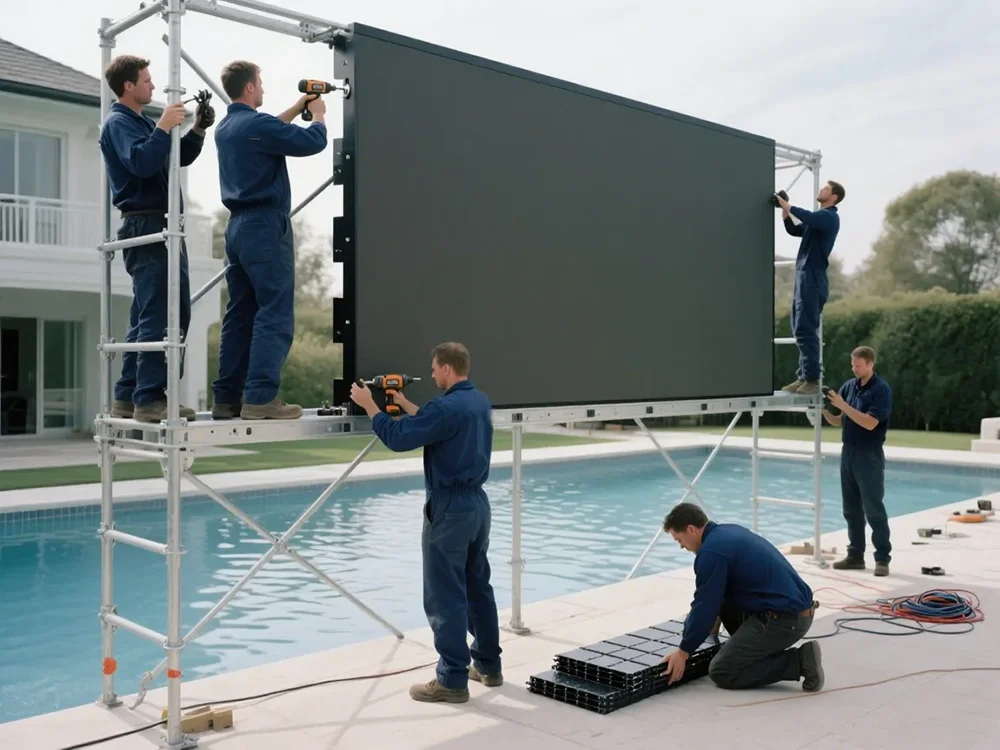
Step 5: Install LED Cabinet and Modules
The installation process usually includes:
1. Install LED Cabinets
Cabinets are fixed onto the supporting structure.
Check:
- Level alignment
- Cabinet connection
- Mechanical stability
2. Connect Power and Signal Cables
Connections include:
- Power cables
- Network cables
- Receiving cards
Correct wiring prevents:
- Screen failure
- Signal interruption
3. Install LED Modules
LED modules are installed into cabinets.
Check:
- Module alignment
- Flatness
- Pixel consistency
Step 6: Configure LED Control System
The control system manages the display content.
Main components:
Sending Card
Transfers video signals from:
- Computer
- Media player
- Video processor
Receiving Card
Controls LED modules inside cabinets.
Video Processor
Used for:
- Multiple signal sources
- Scaling
- Switching
- Advanced video processing
Step 7: Set Up Content Management System
Modern outdoor LED advertising screens support remote content management.
Functions include:
- Video uploading
- Scheduling advertisements
- Remote monitoring
- Multi-screen management
Common content formats:
- MP4 videos
- Images
- Text messages
- Animations
Step 8: Test the Outdoor LED Display
Before operation, complete testing:
Image Testing
Check:
- Brightness
- Color uniformity
- Resolution
- Dead pixels
Electrical Testing
Check:
- Voltage stability
- Power consumption
- Temperature
Weather Testing
Verify:
- Waterproof performance
- Cabinet sealing
- Heat dissipation
二、Outdoor LED Advertising Screen Maintenance Guide
Regular maintenance improves lifespan.
Daily Maintenance
Check:
- Display operation
- Brightness
- Content playback
Monthly Maintenance
Inspect:
- Cable connections
- Cooling fans
- Power system
Regular Cleaning
Remove:
- Dust
- Dirt
- Weather deposits
A clean screen improves brightness performance.
三、Common Problems During Outdoor LED Screen Setup
1. Insufficient Brightness
Cause:
- Wrong LED specification
- Strong sunlight exposure
Solution:
Choose higher brightness outdoor LED modules.
2. Screen Flickering
Possible causes:
- Signal problems
- Low refresh rate
- Power instability
Solution:
Check:
- Controller settings
- Signal cables
- Refresh rate
3. Water Damage
Cause:
- Poor cabinet sealing
- Incorrect installation
Solution:
Use:
- IP65-rated cabinets
- Professional waterproof design
四、How Much Does Outdoor LED Advertising Screen Installation Cost?
The total project cost includes:
- LED display hardware
- Steel structure
- Installation labor
- Electrical system
- Control equipment
- Maintenance
Main cost factors:
- Screen size
- Pixel pitch
- Installation height
- Structure complexity
A professional setup plan can significantly reduce long-term maintenance costs.
五、Outdoor LED Advertising Screen Setup Checklist
Before installation:
☑ Confirm viewing distance
☑ Select correct pixel pitch
☑ Calculate screen size
☑ Check power requirements
☑ Design steel structure
☑ Prepare control system
☑ Test waterproof performance
☑ Plan maintenance schedule
六、Final Thoughts
A successful outdoor LED advertising screen setup requires more than installing LED panels. It involves proper planning of pixel pitch, brightness, structure, power supply, control system, and maintenance.
By selecting the right specifications and following professional installation procedures, businesses can achieve:
- Better advertising visibility
- Longer LED display lifespan
- Lower maintenance costs
- Higher return on investment
A well-installed outdoor LED advertising screen becomes a powerful digital marketing platform that attracts attention and delivers long-term commercial value.
